





Introduction
Alphacool NexXxos ST30 360 Radiator Review

The intention of this write up is to provide information and performance data about the Alphacool ST30 360mm Radiator. We will be including the test results in the Extreme Rigs Rad Round Up 2015, however in this review rather than comparing the ST30 to all the rads we made a decision to start a Round-Up just for the Slim 360mm rads. Expect our Slims Round-Up to be published in the coming weeks.
I’ll be keeping the review section short and factual, focusing on presenting the performance data compiled through the numerous tests carried out. First of all, a big thanks to AquaTuning for providing this sample of the Alphacool ST30!

What’s in the Box?
The ST30 sample came in full retail packaging:

Opening the box, we can see the usual packing layout for the NexXxos series radiators. Alphacool really have done a great job in ensuring that the radiator has every possible chance of arriving to the purchaser in the best possible condition. I really like that the accessories are placed in a separate box at one end of the package.

Extent of delivery:
Alphacool states the following is supplied in the box:
1x Radiator
12x M3x30mm hexagon socket screw
12x M3x35mm hexagon socket screw

All present and accounted for, plus a hex key for the black M3 screws is also included.
The 2 ports are “plugged” with transit caps to keep moisture out.
The “branding” stickers are provided for the user to place where they choose, which is better than when they used to be already stuck onto the side of the rads and half the time were upside down after horizontal installation.
12 each of 30mm and 35mm hex key, button head screws are provided.

Onwards to technical specifications!
Technical Specifications
Technical specifications as listed by Alphacool:
Technical specifications:
Material internal: “Mostly copper”
Material casing: Side panels steel, threads brass, copper chambers
Colour: Black
Dimensions (LxWxH): 400x124x30mm
Connection threads: 2×1/4“
Mounting thread size: M3
Pressure tested: 1.5bar
Weight: 0,970kg

Dimensions Measured on the radiator tested (retail unit):

A variance of 5mm is noticed between my measurements and the length listed in the specs.
I double checked my measurement and again I measured 395mm, the noticed that the tech drawing has an overall length of 397mm, so who knows what Alphacool are measuring.
Radiator Core Dimensions:

The core is a single layer of 15mm x 2mm copper tubes in a standard U-Pattern flow path. The single louvered fins were laid out quite unevenly between the rows tubes and have an averaged count of 14 FPI (Fins Per Inch). The following pic however shows about 16 FPI.
Not a great pic I’ll admit as the ruler is out of focus and not at the start of a fin, but you get the picture.

Finish and Features
The ST30 has a satin black finish, which is in between a full gloss and matte black. The finish is nice and smooth apart from one small blemish on the return end tank, which was a piece of grit or something under the paint.

The ST30 comes equipped with just the 2 ports, inlet and outlet, so no opportunities for drain/fill ports. Some attempt has been made to keep paint out of the G1/4 threads during the paint process.

There is no bleeder/fill port on the return tank end either.

There are screw protector plates fitted under the M3 threads for case installation and fan attachment. As the mounting holes are located directly over the top of the outside tubes, theses plates would save the rad from almost certain unrepairable damage if the wrong length screws were used.
So we have a no frills, slim rad which has a thin core (obviously), but I mention it because it is the second thinnest core of all the rads tested to date. With the medium density fin structure on it’s slim core I can’t help but think that the ST30 doesn’t have much potetntial in the heat dissipation department, but I’ve been wrong before so let’s see how it performs.
Flow Performance
The Data
As all the testing in this round up was performed with the exact same equipment, using the exact same methods I have decided to keep each radiators page uncluttered by posting our testing methodology, test set-ups and equipment used in a single location. To see exactly how the tests were carried out, details of the test set ups and equipment used, please head back to the RRU’15 Test Equipment Page.
Restriction Test
It’s generally agreed that radiators are one of, if not the least restrictive components in the water cooling loop. There are some exceptions however, so this must still be verified through testing:

The above photo is for referencing the restriction test bench. The Alphacool ST30 is not loaded so please disregard the data in the picture as it does not relate to the ST30.
Here is the raw data at the tested flow rates, displaying the measured Differential Pressure across the ST30 as flow rate was increased.

The table numbers indicate that the ST30 is a medium restriction radiator. However numbers in isolation can only tell half the story. By plotting against other components it more easily shows the whole story
I have decided to use a HeatKiller 3.0 CPU block as the reference in these plots for two reasons. Firstly there is no chance of the plot being cluttered by curves overlapping and secondly it gives a reference point against a fairly common loop component of average restriction.
As with all the radiator restriction plots I have limited the maximum flow rate displayed to 2.0 GPM as I suspect there are very few systems that operate above 2.0 GPM. For more information on how to read a restriction plot check out our guide.
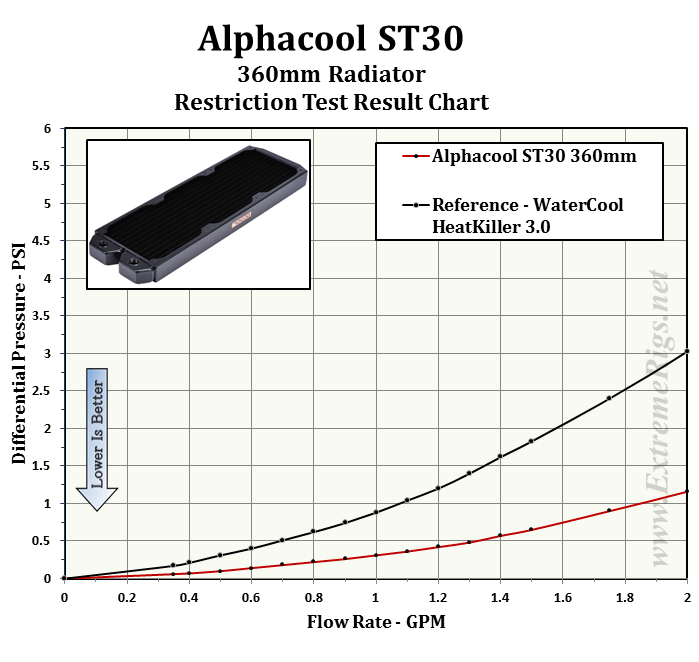 This plot shows us that the ST30 as a low restriction component. Let’s see how it fares against the other radiators in the test group.
The next three plots show the ST30’s restriction level relative to other slim radiators in the test group at 3 different flow rates – what we consider to be low, medium and high system flow rates.


From these tables it would be fair assessment to call the ST30 a Low Restriction Radiator when compared to the other slim 360s, but before we make that conclusion let’s take a quick look at the restriction levels of all our 360 rads at 1.0 gpm.
 So in the big picture of 360 radiators the ST30 is a medium restriction rad, which shows us that sometimes it is better to look at the bigger picture rather than focus on smaller target groups before making assessments based on the data.
Onwards to Thermal Performance!
Thermal Performance
The Thermal Data
Moving on from the restriction test bench the Alphacool ST30 was loaded into the thermal test chamber for a series of 12 tests – consisting of 3 flow rates, each having 3 different fan rpm rates tested. I felt the thermal test data was most important and which you as the reader would be most interested in.
Below is the final data results gathered from at least 2 data logging runs at each flow rate and fan rpm combination. The most stable 15 minute period from each logging run was used and then averaged with the other runs to obtain the data for the table below. A total of 16 temperature sensors were used in the thermal test chamber (8 air in, 2 air out, 3 water in, 3 water out) each take a reading every second and logged via a CrystalFontz unit. The data in the table below is the result of the logging runs which has then been used to create all the plots and tables there-after.

The performance metric of critical importance is the delta between the warm coolant temperature in and the cold ambient air temperature in to the radiator. Given that the system is well insulated and in equilibrium and we know the heat input to the system then we can also calculate a very important number – that is the amount of power required to raise the coolant temperature 1C (or 10C which is more useful reference point).
Let’s take a look at the Delta T results from the tests.
 In this bar chart a couple of very interesting pieces of data show, those being the 1.0 GPM Push Only Delta Temps at 1300 and 1850 RPM. At 1300 rpm the 1.0 GPM Push Only is very close to the 0.5 GPM Push/Pull and Push Only even has a lower Delta Temp at 1850 rpm. This suggests that the second fan is of little benefit when run with low flow rates and medium to high fan speeds as the radiator becomes limited by the coolant flow more than the air flow. This also isn’t too surprising given that the radiator is so slim and doesn’t have high FPI so the benefit of additional fan pressure will be low anyway.
The above info is of course not an apples to apples comparison because of the flow rate difference, I found it interesting though as it is the first time I have seen Push only produce better data results than Push/Pull – even if only by the smallest of margins.
So the performance is not greatly affected by varying flow rate. However Delta T is not always helpful when thinking about how many radiators you would need to cool your system. Instead it’s more useful to know the delta/W, or more usefully, the inverse metric of W/delta C. The metric plotted below tells us how many watts are dissipated by the radiator when the coolant rises 10C above ambient temperatures. (10 Delta T):
 As expected increasing airflow through the radiator is the primary determinant in changing the radiators performance. We can see that the 1850 rpm Push only result outperforms the 0.5gpm Push/Pull results.
This data can now be plotted as a pretty curve so that an end user can interpolate their own fan speed. Note again that the extrapolation of the curve is much more sensitive to error than in between the tested range. Let’s exclude the push data for now and come back to it:

This makes it easier to see that at higher fan speeds that a low flow starts to impact the cooling performance. This makes sense if you take it to the extreme and think about a very low flow rate where the coolant is already cooled 99% of the way to ambient with 10% of its journey through the radiator. In this example the radiator is not being efficiently used. 90% of the radiator surface area would then be wasted and you could have used a smaller radiator. Both coolant flow and air flow can limit thermal performance, however in typical systems flow is a much weaker effect than airflow due to typical choices of fans and pumps.
If we now come back to the push data it’s good to compare only the push to push/pull data in an “apples to apples” fashion by only looking at the 1GPM data:

Push gives close to 89% (averaged) of the performance of Push/Pull across the range tested on this radiator. If you do combine all the plots you’ll also see that at high enough air flow that 1.0GPM Push does overtake 0.5GPM Push/Pull as the flow rate starts to limit performance.
In this next plot all three Push/Pull results at each flow rate were averaged to produce one curve and we compared the results against all of the slim rads we have tested so far. Averaging reduces test error of course so this helps further to be sure of our data and is more useful therefore for comparing to other radiators.
Push Only first up:
 And the Push/Pull Slim rad comparisons:
 The results for both fan assemblies are tightly grouped with the exception of the Koolance EK SE rads. The ST30 performs respectably with both low and medium speed fans, but tapers off a bit with the high speed fans.
Now let’s analyze that data some more…
Push/Pull Data Analysis
Using the data compiled from the Alphacool ST30 thermal testing I have compiled the following tables in an attempt to show other ways of how the ST30 performance varies against itself at the flow rates and fan speeds tested. First let’s take a look at the raw W/10DT numbers we will be using to generate these comparisons:

Effectively these show percentage gains relative to a reference point. It’s an interesting way to show gains/losses while changing a variable. This first table shows performance gain or loss relative to 1.0GPM flow rate:

We can also focus on 1300RPM as our reference and see how much gain or loss in performance we get by changing fan speed:

As expected the change is dramatic. How about we combine both flow rate and fan speed as reference points and have a look at 0.5 GPM & 750 RPM as the reference point.
 Lastly, we change the reference and choose our centre 1300 RPM and 1.0 GPM as our reference point to show both effects concurrently:

So from the data above we can get a very good idea of how the ST30 radiator performs relative to itself. But there is a large selection of 360mm radiator models to choose from, released from numerous manufacturers. So, we need to start comparing performance between them.
Push Only Data vs Competition
Let’s focus on the Push Only results for now and come back to the Push/Pull data later. While for Push/Pull we tested three flow rates, the Push Only testing was conducted only at 1GPM in order to save time. For a comparison vs thicker radiators make sure to check out the 2015 Rad Round Up which compares 27+ radiators including the ST30.
Let’s start with 750 RPM and see how it compares to the competition:

At 750RPM the slim ST30 does well in the comparison and places 2nd among the test group, ~8% behind the winner. However if you compare to the leading slim radiator (the HWLabs GTS) then the performance looks less compelling.

At 1300 RPM the ST30 drops a few spots and is now 10% behind the GTS

At 1850RPM the trend continues which confirms our assessment made in earlier that it’s performance dropped off as the fan speeds increased.
So the ST30 was a decent performer in Push Only which good because is the most likely installation scenario for this radiator. It appears to be better tuned for low fan speeds than most of the competition, but doesn’t fall too far behind with increased fan speeds.
Even though Push/Pull fan assemblies are probably not what the intended use for a slim rad actually is (for most users) we tested it anyway.
So let’s find out how it fared…..
Push/Pull Data vs. Competition
Let’s now look at the Push/Pull results and see how the ST30 360 compares. For Push/Pull we have averaged the results from the 3 flow rates at which we tested.

At 750RPM the ST30 again starts off quite well again placing 2nd. It’s even closer to the GTS this time too. It seems like the Alphacool radiators including the ST30 do benefit more from low speed push/pull than their competitors.

At 1300 RPM the ST30 has fallen behind the leaders

At 1850RPM it falls slightly further again..
Let’s also combine the Push Only and Push/Pull results at the 1.0 GPM flow rate into one plot for each fan speed tested. These plots show just how well the best slim radiators performed against the competition, while showing the ST30’s half decent performance.
Again the 750 rpm first:

At 750 RPM we can see the ST30 would be a great choice – if it weren’t for the GTS. Never the less the ST30 is still a good choice then in terms of space efficiency at low fan speeds.
At 1300 rpm the ST30 is still has OK performance for a slim rad, but it does fall a behind the competitor’s performance as the fan speeds increase, so there are definitely better performance options available.


At 1850 rpm the ST30 no longer seem OK, placing 5th in both Push and Push/Pull assemblies.
From all of test results we created “Average Performance Factor” charts for both Push and Push/Pull and then a combined plot called the “Master Performance Factor”. The radiator with the best cooling ability (W/10ΔT) at each gpm/rpm combo was awarded a score of 100, and each other radiators W/10ΔT result was scored as percentage of the top performer.
This way of looking at the comparison takes away any advantages that a radiator may have at higher or lower fan speeds and looks at an overall average. While this appears fair it does tend to favor those radiators that are all-rounders and those radiators which do very well at high RPM. Most users should be more focused on their specific use case. Check in the Round Up for performance comparisons at every gpm/rpm combo for even more details and cross comparison results.
Here is the ST30’s Push/Pull percentage scores at each data point that thermal tests were conducted at and additionally the 1.0 gpm Push Only percentages relative to the winner at each fan speed.

So looking at these percentages comparatively, we see that the ST30’s performance get’s noticeably worse against the competition as the fan speed is increased. It is a small test group, and it is clear that there was at least one among the test group which did really well with high speed fans for the ST30’s results to be so much in the red. This table also indicates that the ST30 was getting better performance as the flow rate was increase compared to the others.
Then we started averaging the percentage scores at each flow rate giving us the Averaged Performance Factors of each radiator.
Firstly – the Push Only APF:

In Push Only the ST30 finishes in 4th place by the slimmest of margins. It is clear that 4 of the slim rads all had similar performance , while there was one clear winner and one clear loser.

In Push/Pull the ST30’s performance gained ground on the winning rad, but so did it’s rivals, so the ST30 place 5th.
Finally we created the Master Performance Factor which is calculated from the averaged results of all the thermal tests, Push and Push/Pull at all flow rates and all fan speeds.
 In the Master Performance Factor comparisons the ST30 360 finishes in 5th place, or second last
Next up – Summary!
Summary
Thermal Performance
Thermal Performance scores are derived from the relevant Performance Factor scores. We set this scale with 72.5% and below as the 0 mark, with each 2.5% increase from 72.5% in relative performance adding 0.5 to the awarded performance score.
These Bold scores are based on performance comparisons of only the slim 360mm Rads. On the second line is the score which is generated against all the 360mm rads from the complete round up.
Push Only Thermal Performance
- 3.0/5 – Slims Only 360mm rads.
- 1.7/5 – all 360mm rads
The ST30 360’s Push Only thermal performance was good with out being exceptional. Its 89.7 comparative performance factor score equated to a Push only score of 3.0
Push/Pull Thermal Performance
- 3.0/5 – Slims Only 360mm rads.
- 1.1/5 – all 360mm rads
Another category, and another solid performance for the ST30. With a Performance Factor Score of 89.1, the ST30 gets a 3.0/5 for Push Pull Performance.
Overall Thermal Performance
- 3.0/5 – Slims Only 360mm rads.
- 1.4/5 – all 360mm rads
With decent Push Only and Push/Pull results the ST30 generated a 89.4 Master Performance Factor score means that 3.0/5 score is the end result.
Features & Quality – 3.0/5
The ST30 has a smooth, satin black finish that will please the vast majority of purchasers. My review sample had a gritty spot that I noticed on the return tank. I’m prepared to say that the finish is excellent, but not perfect.
The slim design means there is limited material to work with on the tanks, so there are no additional fitting ports on the ST30, nor a bleed/fill/drain port.
There are protector plates for the mounting screws which is a good thing as the mounting holes have tubes directly beneath them.
The main feature of the ST30 is of course its slimness. It was the second slimmest rad of the test group being just 30mm thick (or 80mm with the Push/Pull fans attached). It has the lowest fin count (14 FPI) of the slim rads tested (which helps explain the poor performance) which means it’s not really a dust hog and will require less time dedicated to cleaning and maintenance.
Lastly, I have to mention Alphacool radiators reputation for being the dirtiest rads. Yes, no surprises, this one was no exception. All soldered tube radiators have some residue that must be flushed; it’s just one of those chores that has to be done when preparing to install any new radiator to your loop. However Alphacool seem to have more than the other brands. With the recent launch of specialty radiator cleaning fluids, this chore has been made easier and with far better results than we used to be able to achieve.
Summary – 3.0/5
The ST30’s slim design does not result in outstanding heat dissipation, but for the slim rads we compared against in this review it has decent middle of the pack performance.
As with the other the slim rads the ST30’s biggest draw-card is it’s size, and can fit into places where most other rads on the market don’t stand a chance. Not all cases have the freedom to choose what-ever rad we want due to space constraints. In situations where space is at a premium the ST30 could be just the ticket, particularly if low speed fans are your thing.
There may be other slim rad options that offer better performance or price, but not necessarily in the same radiator, so the ST30 might just be the balance of size, cost and performance that you’re looking for in a slim rad. However for now the Koolance HX-CU1020V and HWLabs Nemesis GTS seem like the better choices for tight spaces.
Where to buy: AquaTuning – $71




[…] Monsta 360 Radiator Alphacool ST30 360 Radiator AquaComputer Airplex Radical Copper 360 Radiator AquaComputer AMS 360 Radiator Coolgate CG 360 […]
[…] ,finde ich den artikel von xtremerigs.net sehr interessant … im Vergleich nexxxos st30 und ut60: Alphacool NexXxos ST30 360 Radiator Review – Page 4 of 6 – ExtremeRigs.net Alphacool UT60 360 Radiator Review – Page 4 of 6 – ExtremeRigs.net da sieht man schon, dass […]
[…] interesting reference for some readers/potential buyers will be our review of the ST30 360mm which we published last year. While not a true 1:1 comparison because of the different […]
The ST30 looks fine for slower/medium speed fans of around 1,000RPM or below? Seems like it’s underrated if you ask me looking at those results..
Comments are closed.